Server
Overview
The server is where you define the services which will be exposed by your application and that can be consumed using asynchronous message exchange. One of the strengths of Reactive System is that streaming data is at its heart (The server is build using Akka Stream) meaning that both requests and responses can be streamed through the server achieving constant memory usage even for very large requests or responses. Streaming responses will be backpressured against the kafka queue utilised by the server.
Define Service using Routing DSL
A Reactive System Route is in essence a map of services exposed by the server indexed against a service id.
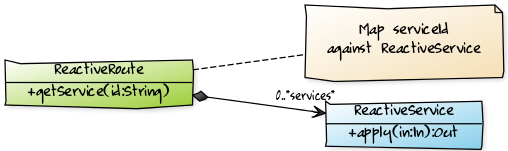
Here is an example how you can create a route:
import org.patricknoir.kafka.reactive.server.dsl._

implicit val system = ActorSystem("SimpleService")
implicit val materializer = ActorMaterializer()

import system.dispatcher

val route: ReactiveRoute = request.aSync[String, String]("echo") {
  in => println(s"received: $in"); s"echoing: $in"
} ~ request.aSync("size") { (in: String) =>
  in.length
} ~ request.aSync("reverse") { (in: String) =>
  in.reverse
}
The above code snipped generates a route that declares 3 services:
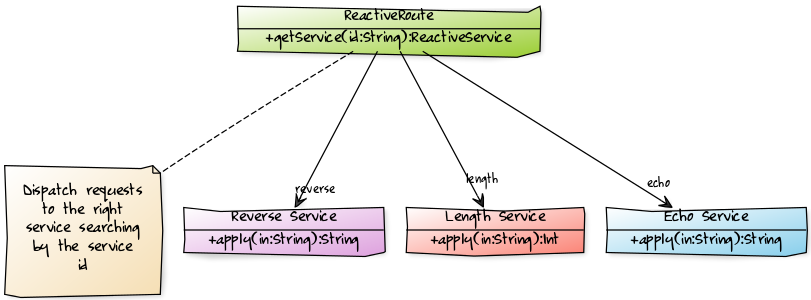
Reactive Services
In order to create a service using a high level API the request object should be used. A service should be a simple function that given an input of type In should return an output of type Out. If you want this code to be executed asynchronously then the request.aSync(serviceId: String)(f: In => Out) should be used, otherwise we offer synchronous execution by using request.sync(serviceId: String)(f: In => Out). A last option is if your function is already returning a future having a signature like the following: f: In => Future[Out], in that case you should be using the request.apply(serviceId: String)(f: In => Future[Out]).
Examples
Here is an example how to execute a function asynchronously:
import org.patricknoir.kafka.reactive.server.dsl._

implicit val system = ActorSystem("SimpleService")
implicit val materializer = ActorMaterializer()

import system.dispatcher

var counter: Int = 0

def getCounter(): Int = counter
def incrementCounter(step: Int): Unit = counter += step

val route: ReactiveRoute = request.aSync[Unit, Int]("getCounter") { _ =>
  getCounter()
}
In this case we will force the incrementCounter function to run synchronously to avoid raise conditions:
import org.patricknoir.kafka.reactive.server.dsl._

implicit val system = ActorSystem("SimpleService")
implicit val materializer = ActorMaterializer()

import system.dispatcher

var counter: Int = 0

def getCounter(): Int = counter
def incrementCounter(step: Int): Unit = counter += step

val route: ReactiveRoute = request.aSync[Unit, Int]("getCounter") { _ =>
  getCounter()
} ~ request.sync[Int, Unit]("incrementCounter") { step =>
  incrementCounter(step)
}
In this last case the getCounter function is already returning a Future[Int] so we will use request.apply:
import org.patricknoir.kafka.reactive.server.dsl._

implicit val system = ActorSystem("SimpleService")
implicit val materializer = ActorMaterializer()

import system.dispatcher

var counter: Int = 0

def getCounter(): Future[Int] = Future(counter)
def incrementCounter(step: Int): Unit = counter += step

val route: ReactiveRoute = request[Unit, Int]("getCounter") { _ =>
  getCounter()
}
Running the server
Once all the services to expose have been defined in the route: ReactiveRoute is time to create an instance of ReactiveSystem and run it.
The simplest way to create and run a ReactiveSystem is the following:
val source = ReactiveKafkaSource.create("simple", Set("localhost:9092"), "simpleService", "serviceGroup", 8)
val sink = ReactiveKafkaSink.create(Set("localhost:9092"), 8)

/**
 * DSL:
 *  val reactiveSys: ReactiveSystem = source via route to sink
 *  val reactiveSys: ReactiveSystem = ReactiveSystem(source, route, sink)
 */
val reactiveSys: ReactiveSystem = source ~> route ~> sink

reactiveSys.run()
Message Delivery Semantics
When creating a server 2 options are available based on the message delivery semantics to be applied:
- At Most Once
- At Least Once
At Most Once Semantic
A Reactive System which implements at-most-once message delivery semantic favours the performance over the consistency. under this condition a Reactive System servers might be losing messages before they are delivered to the router or before a response is sent back to the client. This strategy should be adopted when performance (especially latency) is a key requirement, the system has to serve a huge number of requests/responses mainly read operations which don’t cause side effects. Under these conditions losing a message don’t compromise consistency and if a request message get lost is responsibility of the client to fire another request. An example of adoption of this strategy is the Query part of a CQRS/ES architecture.
Here is an example on how to create a ReactiveSystem with semantic at-most-once:
val source = ReactiveKafkaSource.create("simple", Set("localhost:9092"), "simpleService", "serviceGroup", 8)
val sink = ReactiveKafkaSink.create(Set("localhost:9092"), 8)

/**
 * DSL:
 *  val reactiveSys: ReactiveSystem = source via route to sink
 *  val reactiveSys: ReactiveSystem = ReactiveSystem(source, route, sink)
 */
val reactiveSys: ReactiveSystem = source ~> route ~> sink

reactiveSys.run()
At Least Once Semantic
A Reactive System which implements at-least-once message delivery semantic guarantees that all the requests will be processed by the services ()defined in the route), but in case of failures the messages can be duplicated and the order is not guaranteed if batching is used. Where semantic exactly-once is difficult to achieve or it comes with a huge overhead and can compromise the performance, a similar result can be obtained using at-least-once semantic with Idempotent services, in practice services capable to detect duplicated messages and not triggering side affects twice. This strategy should be adopted when for example implementing Commands in a CQRS/ES architecture making sure the services respect the Idempotence.
Here is an example on how to create a ReactiveSystem with semantic at-least-once:
import org.patricknoir.kafka.reactive.server.dsl._

implicit val system = ActorSystem("SimpleService")
implicit val materializer = ActorMaterializer()

import system.dispatcher

var counter: Int = 0

def getCounter(): Int = counter
def incrementCounter(step: Int): Unit = counter += step

val route: ReactiveRoute = request.aSync[Unit, Int]("getCounter") { _ =>
  getCounter()
} ~ request.sync[Int, Unit]("incrementCounter") { step =>
  incrementCounter(step)
}

val atLeastOnceSource = ReactiveKafkaSource.atLeastOnce(
  requestTopic = "simple",
  bootstrapServers = Set("localhost:9092"),
  clientId = "simpleService"
)
val atLeastOnceSink = ReactiveKafkaSink.atLeastOnce(
  bootstrapServers = Set("localhost:9092"),
  concurrency = 8,
  commitMaxBatchSize = 10,
  commitTimeWindow = 5 seconds
)

val reactiveSystem = atLeastOnceSource ~> route ~> atLeastOnceSink

reactiveSystem.run()